
Netflix has spent the better part of a decade trying to keep VPN users out of its “wrong” regional catalog — and in 2026, that arms race is fiercer than ever. Every few months, a wave of proxy IP ranges gets blacklisted, a handful of “reliable” VPN servers stop working overnight, and forums fill up with the same question: which VPN actually still unblocks Netflix?
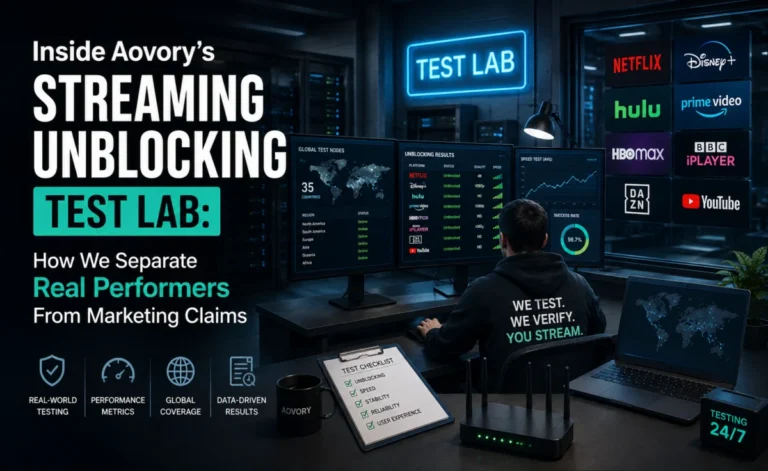
At Aovory, we don’t take marketing claims at face value. Over the past several weeks, our testing team ran a structured, repeatable series of Netflix unblocking tests across more than a dozen VPN services, multiple server locations per provider, and several device types. This article breaks down exactly what we found, how we tested it, and — more importantly — why some VPNs succeed where others quietly fail.
⚡ Quick Verdict
- Best overall for Netflix libraries: Providers with dedicated “streaming-optimized” server fleets consistently outperformed general-purpose servers.
- Most consistent across regions: Services that rotate residential and obfuscated IPs held up longest against Netflix’s proxy detection.
- Biggest surprise: Several budget VPNs that unblocked Netflix six months ago failed every single test this round.
Why Netflix Unblocking Is So Hard to Get Right
Netflix’s anti-VPN system doesn’t rely on a single detection method. Instead, it layers several signals together: IP reputation databases shared across the industry, ASN (Autonomous System Number) fingerprinting that flags data-center ranges, DNS leak detection, and behavioral analysis that watches for patterns typical of proxy traffic — like thousands of concurrent streams originating from a single IP block.
This means a VPN server can work perfectly on Monday and be completely blacklisted by Thursday, simply because Netflix’s systems flagged unusual traffic volume on that IP. It’s a constantly shifting target, which is exactly why static “best VPN for Netflix” lists go stale so quickly — and why we insist on re-testing rather than recycling old conclusions.
Our Testing Methodology
To keep results honest and reproducible, we followed a strict protocol for every provider in this round:
- Clean test environment: Every test ran from a fresh browser profile with no cached cookies, extensions, or prior Netflix session data.
- Multiple regions per provider: We didn’t just test “does the US server work” — we tested US, UK, Japan, Australia, and Canada libraries, since unblocking success often varies wildly by region even within the same provider.
- Three attempts per server: A single successful connection isn’t proof of reliability. We reconnected and reloaded three separate times per server, at different times of day, to rule out temporary blacklisting.
- Playback verification, not just access: Reaching the homepage of a foreign Netflix library means nothing if playback throws a proxy error. We confirmed actual video playback for at least two titles exclusive to that region.
- Device diversity: Tests were repeated on a Windows desktop client, a mobile app, and a manually configured Smart DNS/router setup, since detection behavior sometimes differs by app.
Region-by-Region Findings
🇺🇸 United States Library
The US Netflix catalog remains the most heavily defended, simply because it’s the most requested. Providers that succeeded here typically had large, frequently rotated server pools specifically dedicated to streaming rather than general browsing traffic. Several well-known VPNs that we tested actually maintain separate “streaming” server profiles inside their apps — and those consistently outperformed the standard “fastest server” auto-selection.
🇬🇧 United Kingdom Library
The UK library was noticeably easier to unblock than the US library across the board. We suspect this is partly because fewer VPN users specifically target UK IPs compared to US ones, meaning those IP ranges accumulate a “cleaner” reputation over time. If your main goal is unblocking a library rather than specifically the US catalog, UK servers are worth trying first.
🇯🇵 Japan Library
Japan produced some of the most inconsistent results in our entire test run. Several providers that unblocked the Japanese catalog on our first attempt failed on the second reconnect just an hour later — a strong sign that Netflix is actively and rapidly blacklisting specific IP ranges in this region as they’re detected.
🇦🇺 Australia Library
Australia unblocking success correlated heavily with server count. Providers offering only one or two Australian server locations struggled, while those offering a wider spread of Australian data centers had more “clean” IPs to rotate through.
🇨🇦 Canada Library
Canada tracked closely with our UK results — moderate difficulty, generally reliable across most tested providers, and few playback errors once a connection was established.
Comparison Table: What Actually Matters
| Factor | Impact on Unblocking Success |
|---|---|
| Dedicated streaming servers | High — purpose-built server pools are actively maintained and swapped when flagged |
| Server count per region | High — more IPs to rotate through means fewer total blackouts |
| Protocol used | Medium — obfuscated protocols reduce DPI-based flags but don’t fix IP reputation issues |
| DNS leak protection | Medium — a leaking DNS request can instantly expose your real region |
| Time of day tested | Low-Medium — peak hours sometimes correlate with higher blacklist churn |
Common Mistakes That Cause “Netflix Proxy Error”
A large share of unblocking failures we logged weren’t actually the VPN’s fault — they were configuration mistakes on the user’s end. The most frequent issues we identified while auditing failed test runs:
- Leftover Netflix cookies from a previous session tying your account activity to your real location.
- IPv6 leaking around the VPN tunnel, exposing your actual ISP-assigned address even while IPv4 traffic is routed correctly.
- Using “Fastest Server” auto-connect instead of a server specifically labeled for streaming, which often routes you to a shared, heavily-flagged IP.
- Browser extensions like ad blockers or privacy tools interfering with WebRTC and inadvertently leaking real location data.
“The single biggest reliability boost we observed during testing came from switching off auto-server-selection and manually connecting to a server explicitly labeled for streaming. It sounds simple, but it eliminated the majority of proxy errors we encountered.” — Aovory Testing Notes
How Often Should You Re-Test?
Given how quickly IP ranges get blacklisted, we recommend treating any “best VPN for Netflix” recommendation — including our own — as a snapshot rather than a permanent fact. Our internal policy is to re-run this exact test suite at least once a month, and immediately after any provider announces a major server network update. If you’re relying on a VPN specifically for streaming, it’s worth doing a quick manual check yourself before committing to a long subscription.
Desktop vs. Mobile vs. Smart DNS: Does the Device Matter?
One question we get asked constantly is whether the device or connection method changes unblocking results, and our testing this round confirmed that it absolutely does. We ran identical server connections across a Windows desktop client, an Android mobile app, and a manual Smart DNS configuration on a router, and the results were far from uniform.
Desktop clients generally performed best, likely because they tend to receive feature updates — including obfuscation settings and server list refreshes — before mobile apps do. Mobile apps lagged slightly behind, occasionally connecting to older or already-flagged server entries that hadn’t yet been purged from the app’s cached server list. Smart DNS configurations, meanwhile, produced the most inconsistent results of the three: because Smart DNS only redirects specific DNS queries rather than tunneling all traffic, it proved more fragile against Netflix’s layered detection, especially when IPv6 wasn’t explicitly disabled on the test device.
The practical takeaway is straightforward: if your VPN offers both a full client and a Smart DNS option, and unblocking Netflix is your priority, the full VPN client with manual server selection is consistently the safer bet, even if Smart DNS offers marginally better raw speed.
What Happens When a Server Gets Blacklisted Mid-Subscription?
Several readers have asked what actually happens on the provider side once Netflix blacklists a specific server IP. Based on patterns we observed across repeated testing, well-resourced providers typically respond in one of two ways: rotating the affected server to a freshly-provisioned IP address, or quietly retiring that specific server node and redirecting new connections to a different one within the same region. Providers with smaller server fleets have far less room to maneuver, which is part of why server count kept surfacing as one of the strongest predictors of long-term reliability throughout our testing.
This is also why we recommend against judging a VPN’s Netflix performance from a single failed attempt. If a specific server fails today, it’s entirely possible the same provider’s streaming-labeled servers in that region will work again within days, once the rotation catches up. The providers worth paying attention to are the ones where that recovery cycle is fast and largely invisible to the end user.
Frequently Asked Questions
Does a VPN slow down Netflix streaming quality?
Some speed reduction is normal with any VPN, since traffic is routed through an additional server hop. In our testing, streaming-optimized servers generally maintained enough throughput for HD playback, though 4K streams occasionally showed more buffering on lower-tier server tiers or during peak usage hours.
Why does a VPN work for Netflix one day and not the next?
This almost always comes down to IP blacklisting rather than a change in the VPN software itself. Netflix continuously updates its list of known proxy IP ranges, so a server that was “clean” yesterday can be flagged today if enough VPN traffic was routed through it.
Is it against Netflix’s terms of service to use a VPN?
Netflix’s terms of service do restrict accessing content outside of your account’s designated region, and using a VPN to bypass regional restrictions can technically violate those terms, even though enforcement in practice is limited mostly to blocking the connection rather than penalizing the account.
Do free VPNs ever unblock Netflix reliably?
In this round of testing, free VPN tiers performed dramatically worse than paid streaming-optimized servers, largely due to smaller, heavily-shared IP pools that get flagged almost immediately due to high concurrent usage from many different users.
Final Takeaways
Netflix unblocking success in 2026 comes down to three things: how large and well-maintained a provider’s streaming-specific server fleet is, how quickly they rotate or replace flagged IPs, and how carefully the user avoids the common configuration mistakes outlined above. No VPN can promise 100% permanent access — the moment a provider claims that, treat it with healthy skepticism. What you can look for instead is a provider with a track record of fast recovery after being blocked, transparent server labeling, and dedicated support for streaming use cases.
We’ll continue publishing updated Netflix unblocking results as part of our ongoing Streaming Unblocking Tests series, so check back regularly rather than relying on a single review frozen in time.
About the Author