
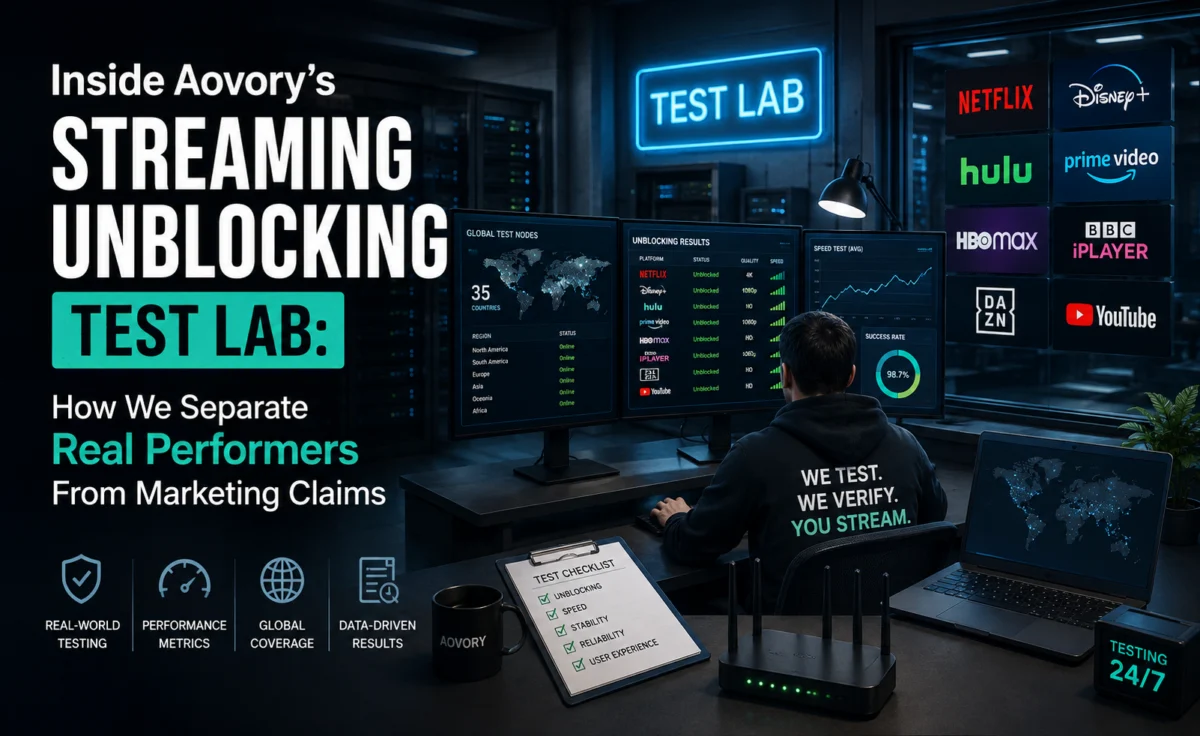
Almost every VPN’s marketing page claims it “unblocks all major streaming platforms.” In practice, that phrase is nearly meaningless. Streaming unblocking performance changes week to week, varies by region, and often differs dramatically between a provider’s advertised capability and what actually happens when you try to press play.
This article pulls back the curtain on how we actually run the tests behind our Streaming Unblocking Tests series — the equipment, the process, the scoring system, and the specific reasons we discard certain types of “successful” tests that other review sites might happily report as a pass.
🔬 The Core Testing Principle
A test only counts as a genuine “unblock” if a real video title plays start to finish without interruption, error, or forced logout — not just if a homepage loads or a login screen appears.
Why Most VPN Streaming Reviews Are Unreliable
The streaming unblocking review space has a structural problem: testing properly is slow, and re-testing regularly is even slower. It’s far faster to load a homepage, see that it says “Netflix” instead of “not available in your country,” take a screenshot, and call it a pass. That approach produces results that look convincing in an article but don’t hold up if a reader actually tries the same server an hour later.
We built our testing process specifically to avoid that trap. Every claim in our Streaming Unblocking Tests series is backed by a documented, timestamped, repeatable test run — not a single screenshot taken under ideal conditions.
Our Four-Stage Testing Pipeline
Stage 1: Baseline Environment Reset
Before any test begins, we reset the testing environment completely: fresh browser profile, cleared DNS cache, no stored streaming service cookies, and a verified “real” IP address confirmed to be outside the target region. This matters more than it sounds — cached session data from a previous successful unblock can make a currently-broken connection look like it’s still working.
Stage 2: Connection and Leak Verification
Once connected to a VPN server, we run a full leak-check sequence before touching any streaming service:
- IPv4 address verification against the target region
- IPv6 leak check (a shockingly common failure point, since many VPN clients only tunnel IPv4 traffic by default)
- DNS leak test to confirm resolver requests aren’t escaping the tunnel
- WebRTC leak check within the browser, which can expose a real local IP even when the visible public IP is correctly masked
Any leak at this stage disqualifies the server from further testing — there’s no point checking whether a service unblocks successfully if the underlying connection is already compromised.
Stage 3: Platform-Specific Access and Playback Test
This is where the actual streaming test happens, and it’s tailored per platform based on what we learned in earlier rounds of this series:
- Homepage load check: Does the platform display region-appropriate content, or an “unavailable” message?
- Title selection: We pick at least two titles known to be exclusive to that region’s catalog, not just any available content.
- Sustained playback: We let playback run for a minimum window (10 minutes for services known to use continuous session monitoring) rather than stopping the moment video starts.
- Repeat connection: We disconnect, reconnect, and repeat the entire test to catch servers that pass once but fail on a second attempt — a pattern we’ve seen often enough to make this step mandatory.
Stage 4: Scoring and Documentation
Every test result is logged with a timestamp, server location, protocol used, device/app tested, and outcome. We use a simple three-tier scoring system rather than a binary pass/fail, because streaming unblocking performance is rarely all-or-nothing:
| Score | Definition |
|---|---|
| Full Pass | Consistent access and full playback across repeated attempts and multiple titles |
| Partial Pass | Access achieved but with inconsistency — some titles or reconnect attempts fail |
| Fail | Blocked at login, DNS/IP mismatch detected, or playback interrupted by proxy error |
What We Deliberately Exclude From Our Tests
Just as important as what we test is what we choose not to count as valid evidence:
- Single-attempt “it worked for me” reports — one successful connection tells you almost nothing about ongoing reliability.
- Homepage-only checks — reaching a region-specific homepage without confirming actual playback is not a genuine unblock.
- Vendor-supplied test results — we don’t accept or reproduce a provider’s own claimed success rates without independently verifying them ourselves.
- Screenshots without timestamps or reproducible steps — without a documented process behind them, they’re not verifiable evidence.
“If we can’t reproduce a result at least twice, we don’t publish it as a pass. Streaming platforms change their detection systems too quickly for one-off luck to count as a finding.” — Aovory Testing Notes
How Often We Re-Test, and Why It Matters
Because streaming platforms update their VPN detection systems on their own schedule — sometimes reactively, sometimes as part of planned infrastructure changes — a result that was accurate last month can become outdated without warning. Our internal policy is to re-run the full test suite for each platform at minimum once a month, with additional ad-hoc testing triggered whenever we notice a spike in reader reports of a previously-reliable server suddenly failing.
This is also why every article in our Streaming Unblocking Tests series carries a clear testing date, and why we treat older articles as historical records rather than evergreen recommendations. A VPN’s streaming performance is a moving target, and any review that doesn’t acknowledge that openly should be read with caution.
What This Means for You as a Reader
When you’re evaluating a VPN for streaming, don’t just look for a provider that claims to unblock a platform — look for evidence of how that claim was tested, when it was tested, and whether the result was reproducible. A single glowing screenshot proves far less than a documented, repeatable process.
Our goal with this methodology article is to make our own testing process fully transparent, so that when you read a verdict in any of our streaming unblocking articles, you know exactly what standard that verdict had to meet before we were willing to publish it.
The Tools and Checks Behind Every Test
Transparency about methodology also means being transparent about the actual tools involved in each test run. Every session in our pipeline includes independent verification steps that don’t rely on the VPN provider’s own app telling us “connected successfully.” We cross-check the visible public IP address against multiple independent geolocation databases rather than trusting a single source, since IP-to-region mapping data can occasionally be outdated or inconsistent between providers.
DNS leak checks are run through a dedicated resolver-tracing process that identifies exactly which server actually answered a DNS query — not just whether a leak-check website displays a green checkmark, which can sometimes give a false sense of security if the check itself doesn’t probe deeply enough. WebRTC leak testing is performed directly within the browser environment used for the streaming test itself, rather than as a separate, disconnected check, since WebRTC behavior can vary meaningfully between browsers and even between browser versions.
We also log connection latency and packet loss during each sustained playback test, which has proven useful for explaining why some “Full Pass” results still come with a caveat about buffering or reduced video quality, even when the core unblocking succeeded without any proxy errors.
Handling Conflicting Results Across Testers
Because our testing team runs sessions independently across different physical locations and different underlying internet connections, we occasionally get conflicting results for the exact same VPN server on the exact same day. Rather than treating this as a testing failure, we treat it as useful data in itself — it’s a strong signal that a particular server or IP range is in an unstable, actively-being-flagged state rather than either cleanly working or cleanly blocked.
In these cases, our published verdict reflects the more conservative outcome, and we note the inconsistency explicitly rather than picking whichever result looks more favorable. This is a deliberate editorial choice: an honest “results were inconsistent” is more useful to a reader than an artificially confident pass or fail based on incomplete data.
Frequently Asked Questions
How many VPN servers do you actually test per article?
The exact number varies by article, but our standard round typically covers multiple server locations per provider across several regions, with each server tested more than once to check for consistency rather than relying on a single connection attempt.
Do you accept payment or free subscriptions from VPN providers in exchange for coverage?
Our testing methodology is designed specifically so that results are independently reproducible regardless of how access to any given service was obtained, and our published verdicts reflect only what our documented test runs actually showed.
Why do your results sometimes differ from other VPN review sites?
Differences often come down to methodology rather than the underlying VPN performance itself. A site that counts a homepage load as a “pass” will naturally report higher success rates than one that requires sustained playback confirmation, even when testing the exact same server.
How can I run a similar leak-check process myself before trusting a VPN for streaming?
At minimum, checking your visible IP address, running a dedicated DNS leak test, and confirming no WebRTC leak is present in your specific browser before starting a streaming session will catch the majority of the configuration issues we identified during our own testing.
Looking Ahead
We’re continuing to refine this testing pipeline as streaming platforms evolve their detection methods. Upcoming additions to our process include automated leak-check logging and expanded playback-window testing for platforms we suspect are moving toward continuous session monitoring, similar to what we documented with Disney+ in our previous article. As always, the goal isn’t to crown a single “winner” — it’s to give you an honest, current, and reproducible picture of what actually happens when a VPN meets a streaming platform’s defenses.
About the Author