
Aovory Editorial // Console Exclusives
Ten Console Exclusives That Still Define the Medium
Why hardware-tied games remain the strongest argument for buying a specific console — and which ones prove it.
The console exclusive is a strange kind of promise. A platform holder is essentially betting hundreds of millions of dollars that a single game — or a small handful of them — can justify the entire purchase of a box under your TV. Most of the time, that bet doesn’t fully pay off. But every so often, an exclusive arrives that doesn’t just sell hardware; it reshapes what players expect from the medium entirely, and its fingerprints show up in genres and studios that have nothing to do with the console it launched on.
We put together a list of ten exclusives — some recent, some decades old — that we think still hold up as genuine arguments for the hardware they were built for. This isn’t a ranked countdown; it’s closer to a hall of fame, ordered loosely by console generation. We also tried to avoid the trap of picking games purely because they were commercially huge — plenty of best-sellers are perfectly good without ever changing what the medium is capable of. The criteria here is narrower and, we think, more interesting: did this game do something that other developers spent the next several years trying to catch up to, whether they were making exclusives themselves or not?
1. Halo: Combat Evolved
It’s easy to forget how radical Halo felt on release, mostly because everything that came after it copied its homework. Regenerating shields, the two-weapon limit, vehicles you could commandeer mid-firefight — these weren’t just neat ideas, they were a working blueprint for console shooters that had, up to that point, mostly been trying to imitate PC mouse-and-keyboard design with a controller bolted on. Halo didn’t imitate anything. It built a control scheme and a pace specifically for a gamepad, and in doing so, it made the console shooter a legitimate genre rather than a compromise.
2. Gran Turismo
Long before “sim racing” was a category with its own hardware ecosystem of wheels and pedals, Gran Turismo made the case that a racing game could be obsessive about realism without losing its arcade accessibility. The sheer density of its car list, the tuning depth, the license tests that functioned as a driving school — it set a template that racing games are still measured against, and it turned console racing from a genre about lap times into a genre about ownership, tinkering, and taste.
3. Metroid Prime
Taking a beloved 2D franchise into a first-person 3D perspective is one of the riskiest moves a studio can make, and Metroid Prime is still the reference point people cite when that gamble actually works. It preserved the exploratory, isolating atmosphere of the original games while inventing an entirely new way to move through that world, using the visor as both an interface and a storytelling device. Two decades later, the “environmental storytelling through a first-person scanner” trick still shows up in games that have never heard of Metroid.
4. The Legend of Zelda: Breath of the Wild
Open-world design had calcified into a fairly predictable formula by the time Breath of the Wild arrived — map full of icons, towers to climb for vision points, a checklist posing as exploration. Breath of the Wild tore that formula up and replaced it with physics-driven systems that rewarded genuine curiosity: climb anything, burn anything, combine anything. It didn’t just refresh its own series; it forced an entire genre to reconsider what “open world” was supposed to feel like, and the ripple effects are still visible in how newer open-world titles design their systems.
5. God of War (2018)
Reinventing a franchise this far into its life is rare, and doing it successfully is rarer still. The decision to shift from arcade-style hack-and-slash combat to a slower, weightier, over-the-shoulder camera — combined with turning Kratos from a rage machine into an actual father wrestling with his own legacy — could easily have alienated the existing audience. Instead, it broadened it dramatically, and it’s become the go-to case study for how a mature franchise can evolve its combat and its emotional register at the same time without either feeling grafted on.
6. Bloodborne
Bloodborne took the deliberate, shield-first combat rhythm that had defined its developer’s earlier work and inverted it: no shields, aggressive positioning rewarded over caution, a rally system that pushed players to attack their way back to health rather than retreat. Layered over a gothic, Lovecraftian setting that felt distinct from anything else on shelves at the time, it proved that punishing difficulty and atmospheric horror could coexist with genuinely fluid, aggressive combat — a combination plenty of games have chased since.
7. Super Mario Odyssey
Every few console generations, a Mario platformer arrives that resets the bar for what 3D platforming can feel like, and Odyssey is the current high-water mark. The capture mechanic — possessing enemies and objects to solve traversal puzzles — turned every level into a toolbox rather than a fixed obstacle course, and the sheer density of ideas packed into each kingdom is still startling on repeat playthroughs. It’s a masterclass in how a decades-old mascot platformer can still feel inventive rather than nostalgic.
8. The Last of Us
Narrative-driven console games existed long before The Last of Us, but few had married mechanical tension — scavenging for scarce resources, stealth that actually felt dangerous — with a story this committed to its characters’ emotional damage. It became the reference point for “prestige” console storytelling, and its influence is visible in how many studios now treat pacing, silence, and character writing as core design pillars rather than an afterthought layered on top of the gameplay loop.
9. Ratchet & Clank: Rift Apart
Sometimes an exclusive’s importance is technical rather than narrative. Rift Apart’s dimension-hopping mechanic — instantaneous, seamless transitions between wildly different environments — was less a gameplay gimmick than a direct demonstration of what a new console generation’s storage architecture actually enabled. It made an abstract hardware spec sheet tangible in a way marketing copy never could, giving players a concrete answer to “what does faster storage actually get me?”
10. Final Fantasy VII
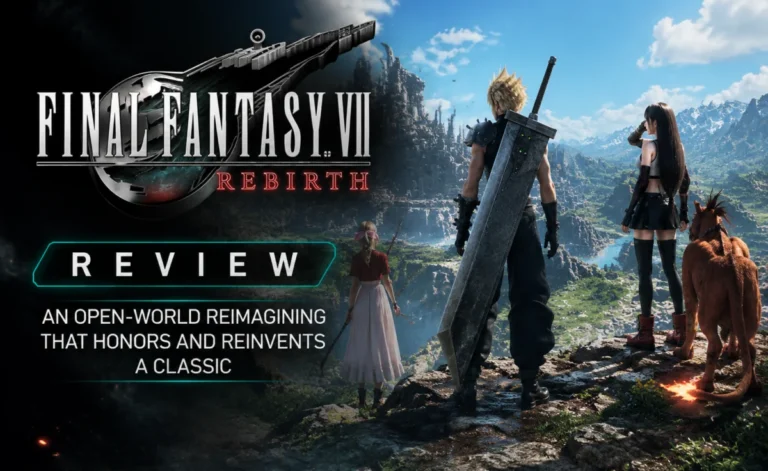
It’s hard to overstate how much Final Fantasy VII changed the commercial trajectory of console role-playing games in the West. Its combination of pre-rendered backgrounds, a cinematic opening sequence, and a story willing to kill a major character partway through introduced an entire generation of players to the idea that a console RPG could carry the emotional and narrative weight of a film. Console JRPGs existed before it, but the genre’s mainstream Western audience largely starts here.
Honorable Mentions
Cutting this list to ten meant leaving out games that easily could have made the cut on a different day. A few deserve a mention before we move on:
- Persona 5: Turned a genre known for dense menus and dry pacing into something with genuine style — its UI design alone influenced how menu-heavy games approach visual identity.
- Horizon Zero Dawn: Proved that a new IP, not a legacy franchise, could carry a console’s technical showcase moment, and did it with a world-building approach that treated its post-apocalyptic setting as a mystery worth uncovering slowly.
- Splatoon: Took the shooter genre, stripped out lethality entirely, and rebuilt it around territory control — a genuinely novel idea in a genre that rarely reinvents its core loop.
- Demon’s Souls: The originator of an entire design philosophy that would eventually become one of the most influential in modern game design, exclusive to the hardware that introduced it.
None of these needed to be on the main list to matter — that’s really the point. The bench of console-defining exclusives is deep enough that reasonable people will always argue about the final cut, and that argument is part of what makes exclusives such a compelling part of console culture in the first place.
What Ties Them Together
Looking at this list as a whole, a pattern emerges: none of these games are remembered simply because they looked good for their era, though most of them did. They’re remembered because each one solved a specific design problem — how to make a shooter feel native to a gamepad, how to make an open world feel genuinely open, how to make horror and combat coexist — in a way nobody had quite managed before. That’s the real function of a console exclusive at its best. It’s not just a sales pitch for a piece of hardware; it’s a proof of concept for an idea the rest of the industry hasn’t caught up to yet.
If you’re building a case for which console to buy next, specs and price will only get you so far. The better question is almost always: which of these ideas do you want to experience first, on the hardware it was actually built for?
Written by the Aovory Team — independent coverage of console gaming, hardware, and the culture around them. More at aovory.com.
About the Author