

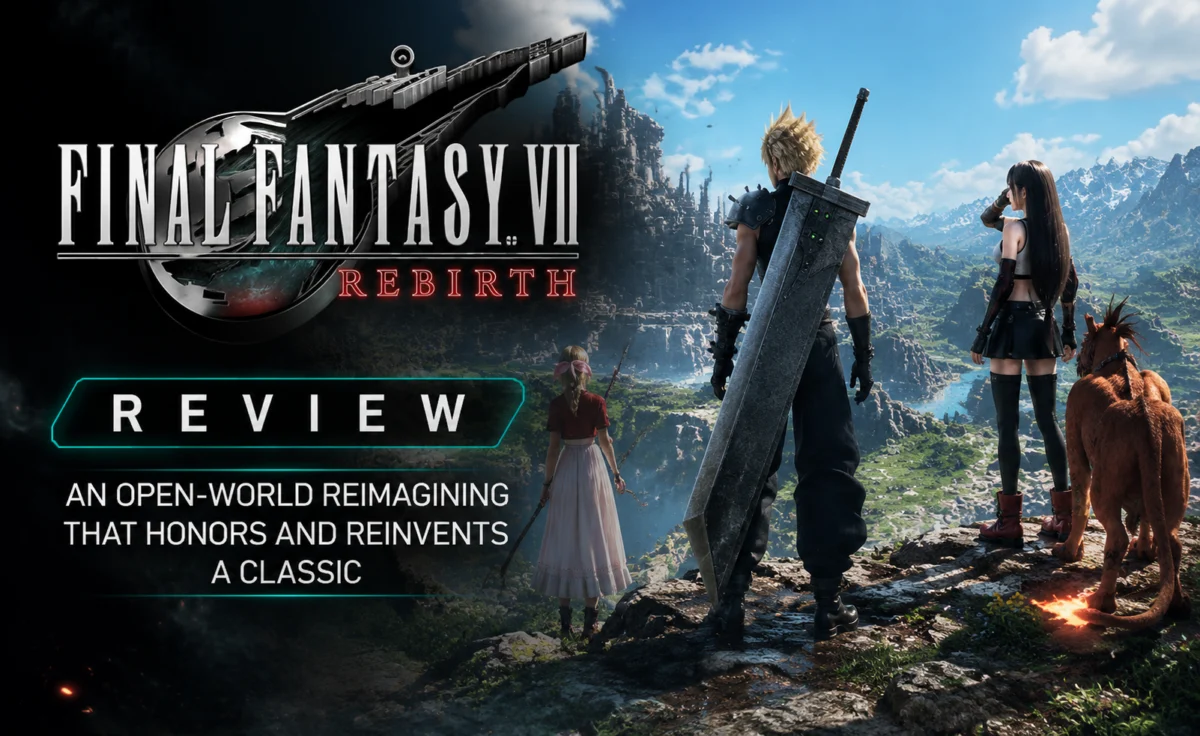
Platform: PlayStation 5 | Genre: Action-RPG | Rating: 9.3/10
The second entry in Square Enix’s ambitious three-part reimagining of Final Fantasy VII had an enormous task ahead of it: leave the claustrophobic, industrial confines of Midgar behind and open up into the sprawling, varied world map that defined the original 1997 release for an entire generation of RPG fans. Rebirth doesn’t just meet that challenge — it uses the freedom of open-world design to deepen character relationships the original could only gesture at with static field sprites and text boxes.
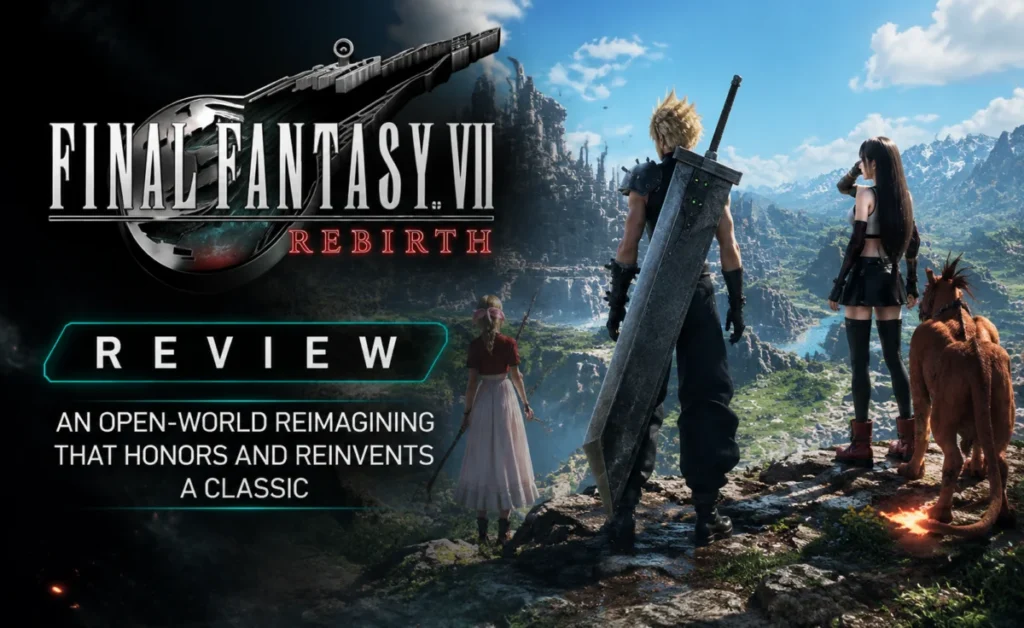
From Corridor to Continent
Where 2020’s Remake confined players to Midgar’s slums and plate-covered sectors, Rebirth throws open the Grasslands, the Junon coast, the Gold Saucer, and beyond into fully explorable open regions, each built around a mix of main-story progression, Chadley’s now-expanded intel network of towers and world activities, and a genuinely surprising density of optional character content.
The open-world structure inevitably invites comparisons to modern Ubisoft-style map design — towers to climb, icons to clear — and Rebirth doesn’t entirely escape that comparison. But the team consistently uses those activities as delivery mechanisms for character writing rather than pure busywork; a seemingly throwaway side quest chasing a Chocobo or fishing at a remote dock frequently pays off with a genuinely touching Cloud-and-party conversation that deepens the ensemble in ways the side content structure alone wouldn’t suggest.
Rebirth’s smartest trick is treating open-world checklist design as a vehicle for character intimacy rather than a substitute for it.
Combat Evolved, Not Replaced
The Remake’s real-time-with-tactical-pause ATB hybrid combat returns largely intact, but Rebirth meaningfully expands the roster’s synergy options. New Synergy Abilities let two party members combine attacks for powerful, resource-efficient combos, while Synergy Skills provide passive battlefield bonuses simply for keeping certain characters in your active party together. The result is a combat system that rewards players for experimenting with party composition rather than settling into one optimal team for the entire eighty-plus-hour campaign.
Party and Materia Systems
- Seven playable party members are available across the campaign, each with a genuinely distinct combat identity
- The Materia system returns largely unchanged from Remake, layering magic, support, and command abilities onto weapons and armor
- Character-specific “Folio” ability trees add meaningful build customization beyond simple Materia slotting
- Difficulty options range from a story-focused Easy mode to a punishing Dynamic mode for series veterans
The Gold Saucer: A Minigame Paradise
Longtime fans of the original waited decades to see the Gold Saucer rebuilt in full 3D, and Rebirth delivers arguably too much content here rather than too little. Chocobo racing, a card game (Queen’s Blood) deep enough to function as its own standalone product, a rhythm-based piano minigame, and a full 3D brawler-style combat arena all exist as fleshed-out systems rather than one-off gimmicks — Queen’s Blood in particular has developed a genuinely dedicated online community discussing deck strategies since launch.
Story Pacing and the Original’s Shadow
Rebirth carries the heaviest narrative burden of the trilogy, covering the original game’s entire midsection — a stretch that includes the story’s most emotionally significant moment for longtime fans. Without spoiling specifics, the game’s handling of this sequence blends faithful staging with newly introduced narrative ambiguity carried over from Remake’s ending, a choice that has proven divisive among longtime fans but which the team commits to with genuine confidence rather than hedging.
Visual and Technical Presentation
Character models represent a significant leap over Remake, particularly in facial animation during the game’s frequent, lengthy cutscenes. Performance Mode targets a largely stable 60fps at the cost of some resolution and effects fidelity, while Graphics Mode pushes for a sharper 4K-adjacent image at 30fps. Draw distance across the open regions — particularly the Grasslands’ rolling hills and the Gongaga jungle’s dense canopy — showcases some of the most impressive environmental art design on PS5 to date.
Music
Composer Masashi Hamauzu leads a team reworking dozens of the original 1997 soundtrack’s most iconic themes into fully orchestrated, dynamically shifting arrangements that change instrumentation based on combat intensity or story context. Long-time fans will recognize melodic callbacks buried throughout even brand-new compositions, a level of musical craftsmanship that rivals the visual remake work happening on screen.
Pros and Cons
| Pros | Cons |
|---|---|
| Open-world regions dramatically expand character and world-building depth | Tower-and-icon activity structure occasionally feels formulaic |
| Combat synergy systems add genuine strategic depth to party building | Story’s handling of a major original-game moment will divide longtime fans |
| Gold Saucer minigames are deep enough to function as standalone experiences | Pacing sags slightly in the campaign’s middle third |
| Outstanding reimagined soundtrack and visual presentation | Some open-world side content rewards feel more cosmetic than mechanical |
Queen’s Blood: An Unexpected Standout
Special mention has to go to Queen’s Blood, the collectible card minigame woven throughout the campaign as optional but richly rewarded content. Far from a throwaway distraction, Queen’s Blood features escalating tactical depth across dozens of unique opponents, each requiring different deck strategies to overcome, and card rewards that meaningfully improve as players progress deeper into its optional tournament ladder. It says something about the strength of Rebirth’s core design that a minigame originally intended as a side attraction has become, for a significant portion of the player base, nearly as compelling a reason to keep playing as the main story itself.
Accessibility and Difficulty Options
Square Enix has expanded accessibility support considerably compared to Remake, offering a wider range of difficulty presets, adjustable enemy aggression and damage sliders, and assist options for the game’s more demanding late-game combat encounters and boss fights. A dedicated “Story” difficulty setting removes most combat friction for players primarily invested in narrative and exploration, while Dynamic difficulty mode caters to series veterans looking for the tactical depth the ATB hybrid system is capable of at its most demanding.
How Rebirth Compares to Remake
Where Remake was constrained almost entirely to corridors, elevators, and Midgar’s oppressive industrial sprawl, Rebirth benefits enormously from simply having room to breathe. Combat encounters take place across genuinely varied terrain rather than repeated arena-style setpieces, side content carries real narrative weight rather than existing purely to extend playtime, and the party’s chemistry — barely hinted at during Remake’s more plot-heavy pacing — gets consistent space to develop across dozens of smaller character moments. Fans who found Remake’s linearity limiting will find Rebirth addresses that critique about as thoroughly as a middle chapter reasonably could.
What to Expect From the Trilogy’s Conclusion
With Rebirth ending on a cliffhanger that recontextualizes several long-standing plot threads from the original 1997 game, anticipation for the still-unannounced final chapter is understandably high. Based on the narrative ambiguity introduced across both Remake and Rebirth, longtime fans should expect the trilogy’s conclusion to continue blending faithful adaptation with genuine narrative risk-taking, rather than settling for a shot-for-shot recreation of the original ending.
Chocobo Variants and Regional Traversal
Each open-world region introduces a distinct Chocobo variant with a unique traversal ability — climbing sheer cliff faces, gliding across canyons, or swimming through deep water — turning what could have been a simple fast-travel mount into an additional layer of region-specific puzzle-solving. Capturing and taming each regional Chocobo becomes its own small side-quest arc, and the design team’s willingness to tie a core traversal mechanic directly into optional content rewards curious exploration in a way that mirrors the franchise’s classic charm for series veterans.
Party Banter and World Intel
Scattered throughout the open regions, optional party banter sequences trigger during downtime exploration, letting the cast riff on their surroundings, their history together, and lighter comedic material that balances out the story’s heavier plot beats. Combined with Chadley’s expanded world intel system — which frames combat simulator challenges and regional reports as an in-fiction research project rather than a disconnected checklist — the open world’s optional content consistently reinforces character relationships rather than existing as generic collectible padding.
A Note on Runtime and Content Density
Between the main story, Chadley’s world intel activities, Gold Saucer minigames, and optional character content, a completionist playthrough of Rebirth comfortably exceeds one hundred hours — a genuinely enormous scope for a single middle chapter in a planned trilogy. Players focused purely on the main narrative can expect a considerably shorter but still substantial forty-to-fifty-hour campaign, meaning the game scales reasonably well to differing appetites for open-world side content without ever feeling like the main story alone is thin or padded to compensate.
Final Thoughts on the Trilogy’s Trajectory
Taken as a whole, the Remake trilogy’s decision to expand a roughly ten-hour section of the original 1997 game into two full-length releases (with a third still to come) is an enormous structural gamble, and Rebirth is the entry that most clearly justifies it. The character work, combat depth, and sheer content generosity on display here make a compelling case that this expanded approach, whatever its pacing costs, has ultimately produced a richer, more emotionally resonant version of this story than a single condensed remake ever could have.
Final Verdict
Final Fantasy VII Rebirth takes real risks with one of gaming’s most beloved stories and mostly justifies every one of them. By using open-world freedom to deepen character relationships rather than simply pad runtime, it becomes something rare: a middle chapter that feels essential rather than transitional. Combat depth, technical presentation, and sheer content density all mark clear improvements over Remake, even as certain structural open-world conventions occasionally hold it back from greatness.
Aovory Score: 9.3/10 — An ambitious, occasionally overstuffed, but ultimately triumphant middle chapter.
About the Author