
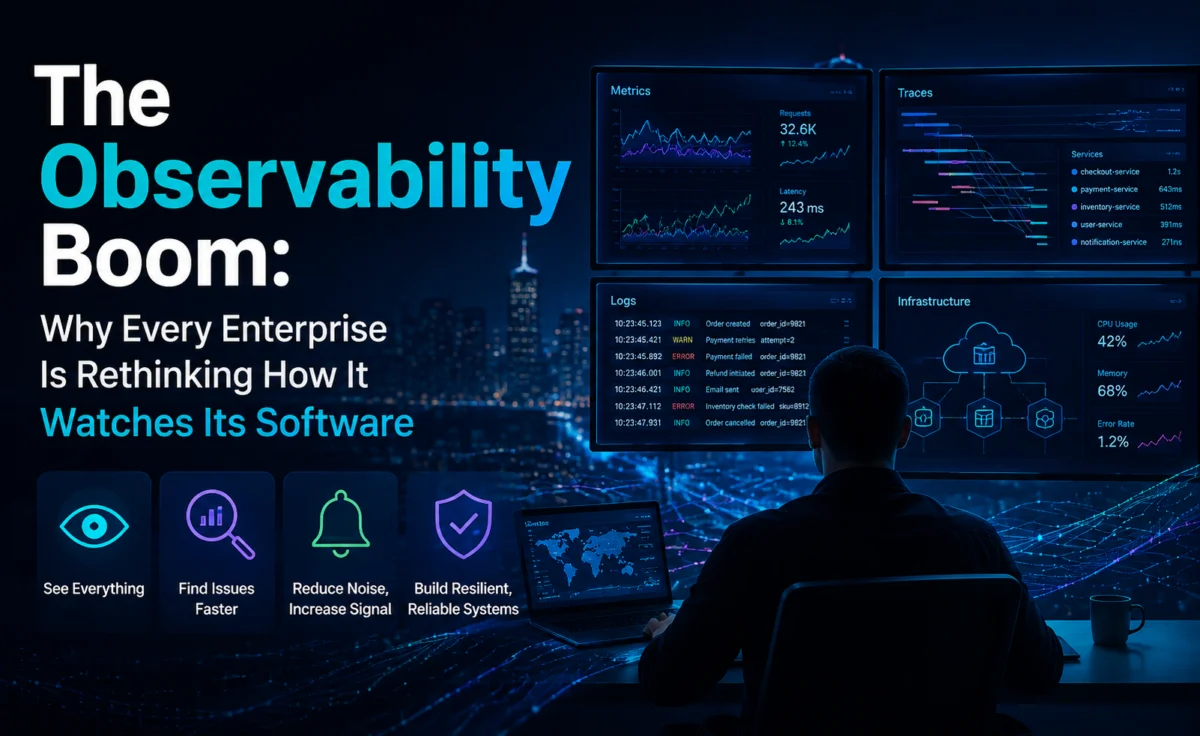
Somewhere between the AI hype and the release-cadence race, a quieter but arguably more consequential shift has been building in enterprise software: the industry’s sudden, urgent obsession with observability. Market research circulating this year projects the global observability tools and platforms market growing to nearly $23 billion by the early 2030s, and the demand curve behind that number is not abstract — it’s a direct response to the fact that software systems have become too complex, too distributed, and too automated for humans to monitor the old-fashioned way.
Why Now? Three Forces Colliding
Observability — the practice of instrumenting software so you can understand its internal state from the outside, through logs, metrics, and traces — is not a new idea. What’s new is the intensity of demand for it, and that intensity traces back to three forces converging at once.
1. AI Agents Are Now Part of the Production Stack
As agentic tools move from writing code to actually operating parts of the software delivery lifecycle — deploying changes, responding to incidents, even making judgment calls about rollbacks — the question of “what is this system actually doing right now, and why” has gone from a nice-to-have to an existential requirement. You cannot safely delegate operational decisions to an autonomous system you can’t observe in detail. Several platform vendors have explicitly extended their offerings this year to cover the full AI agent development lifecycle, treating agent behavior itself as something that needs the same monitoring rigor as a traditional microservice.
2. Distributed Systems Have Gotten More Distributed, Not Less
Despite years of predictions that architecture would simplify, the opposite has happened. Microservices, edge computing, multi-cloud deployments, and now a growing layer of AI inference infrastructure sitting alongside traditional application logic have all added surface area. A single user request today might touch a dozen services across multiple providers before a response comes back — and when something goes wrong, tracing the failure back to its root cause without proper instrumentation is close to impossible.
3. Incident Response Has Become a Board-Level Concern
High-profile outages this year — some tied directly to unreviewed AI-generated changes, others to plain old infrastructure complexity — have pushed incident response from an engineering-team concern to a topic that shows up in board meetings. Live webinars and certification programs on building AI agent evaluation frameworks specifically for high-stakes incident response have drawn strong attendance this year, a signal that organizations are treating this as a skills gap worth actively closing, not just a tooling purchase.
🔍 The Core Shift in One Sentence
Observability used to be about understanding what your software did. Now it has to explain what your AI did, why it did it, and whether it should be allowed to do it again.
What “Good” Observability Looks Like in 2026
The bar for observability tooling has risen sharply, and a few characteristics now separate leading platforms from the pack:
- Unified telemetry across traditional and AI workloads. Logs, metrics, and traces from conventional services now need to sit alongside model inference latency, token usage, agent decision traces, and tool-call histories in a single coherent view.
- Explainability, not just alerting. An alert that says “error rate spiked” is no longer sufficient when the root cause might be an AI agent that made a subtly wrong decision three steps upstream. Modern platforms increasingly aim to reconstruct the reasoning chain, not just the symptom.
- Automated correlation across noisy signals. As instrumentation volume grows, the ability to automatically correlate related signals into a single incident narrative — rather than dumping a wall of raw alerts on an on-call engineer — has become a genuine competitive differentiator among vendors.
- Governance and audit trails built in. With AI systems increasingly making autonomous changes to production, observability platforms are being asked to double as compliance tooling — proving, after the fact, exactly what changed, when, and under whose authorization.
Independent Analyst Recognition
Industry analyst firms have begun publishing dedicated evaluations of this space, recognizing a growing field of specialized providers focused specifically on workflow and content automation, alongside more traditional infrastructure-monitoring vendors — a sign that the category is maturing from a single niche into several distinct sub-markets with different buyer profiles and different technical priorities.
The Buyer’s Dilemma: Consolidate or Specialize?
Enterprise buyers evaluating this space face a genuine strategic fork. One path is consolidation: adopt a single observability platform that aims to cover everything — infrastructure, applications, and AI workloads — accepting some depth trade-offs in exchange for a unified view and a single vendor relationship. The other path is specialization: assemble a best-of-breed stack of point solutions, each excellent at one layer, accepting the integration overhead in exchange for deeper capability at each layer.
Neither answer is universally correct, and the right choice depends heavily on organizational maturity. Teams with strong platform engineering capability tend to get more value out of specialization, because they have the internal expertise to stitch tools together effectively. Teams without dedicated platform engineering resources are generally better served by consolidated platforms, even at the cost of some flexibility, simply because the integration tax of a best-of-breed approach can quietly consume more engineering time than the tooling saves.
Questions Worth Asking Before Buying
- Can this platform trace a request end-to-end across both traditional services and AI inference calls?
- Does it explain why something happened, or only that something happened?
- How does it handle alert fatigue — does it correlate signals, or just forward every raw alert?
- Does it produce audit-ready records suitable for compliance and governance reviews, not just engineering dashboards?
- What is the actual time-to-root-cause during a real incident, measured, not promised?
The Cost of Getting This Wrong
Organizations that under-invest in observability while simultaneously increasing their reliance on AI-driven automation are, in effect, accepting a growing blind spot at exactly the moment their systems are making more autonomous decisions than ever before. The pattern showing up in post-incident reviews this year is consistent: the organizations that struggled longest to resolve major incidents were disproportionately the ones running extensive automation without the observability depth to match it. Speed without visibility is not a sustainable trade.
Inside a Modern Observability Stack
To make the abstraction concrete, it helps to walk through what a well-built observability stack actually looks like inside an organization that has taken this seriously in 2026, layer by layer.
- Ingestion layer. Every service, container, and AI inference call emits structured logs, metrics, and traces to a common collection pipeline, tagged consistently enough that signals from wildly different parts of the stack can be correlated later without manual translation work.
- Correlation layer. Rather than presenting engineers with a raw firehose of individual signals, the platform groups related events into coherent incident narratives — this deployment, followed by this latency spike, followed by this specific agent decision, followed by this user-facing error.
- Explainability layer. For AI-driven components specifically, this layer reconstructs not just what happened but the reasoning trail behind an automated decision — which inputs the system considered, which tool calls it made, and why it chose the path it did.
- Governance layer. An audit-ready record of every change, who or what authorized it, and what the observable impact was — increasingly a requirement for regulated industries and a growing expectation even outside them.
- Response layer. Automated or human-assisted remediation, ranging from simple auto-rollback rules to structured incident-response playbooks that route the right signal to the right on-call engineer with the context already assembled.
Organizations that have built out all five layers report meaningfully shorter incident resolution times than those relying on a patchwork of legacy monitoring tools bolted together after the fact. The gap isn’t subtle — several teams reporting on their year-over-year incident metrics have described reductions in mean time to resolution measured in multiples, not percentages, after completing a full observability overhaul.
The Talent Question
Building and operating a stack like this requires a skill set that barely existed as a distinct discipline a few years ago: engineers who understand both traditional distributed-systems monitoring and the newer demands of explaining AI agent behavior. Demand for this hybrid skill set has outpaced supply throughout the year, and it shows up clearly in how aggressively companies are investing in internal training and certification programs specifically focused on operating AI systems safely in production, rather than assuming existing site-reliability engineering skills transfer automatically.
The Bottom Line
Observability has quietly moved from a backend engineering concern to one of the central strategic questions in enterprise software procurement. As AI systems take on more autonomous responsibility inside production environments, the ability to see, explain, and audit what those systems are actually doing is no longer optional infrastructure — it’s the difference between an incident that gets resolved in minutes and one that makes headlines for the wrong reasons. Expect this category to keep absorbing enterprise budget and attention for the remainder of the year.
Aovory will continue covering the observability and enterprise monitoring space as new platforms and governance standards emerge.
For technology leaders weighing where to invest next, the practical signal is clear: treat observability not as a line item to trim during budget season, but as the connective tissue that makes every other 2026 software bet — agentic automation, faster release cadences, distributed architectures — actually safe to run at scale.
About the Author