

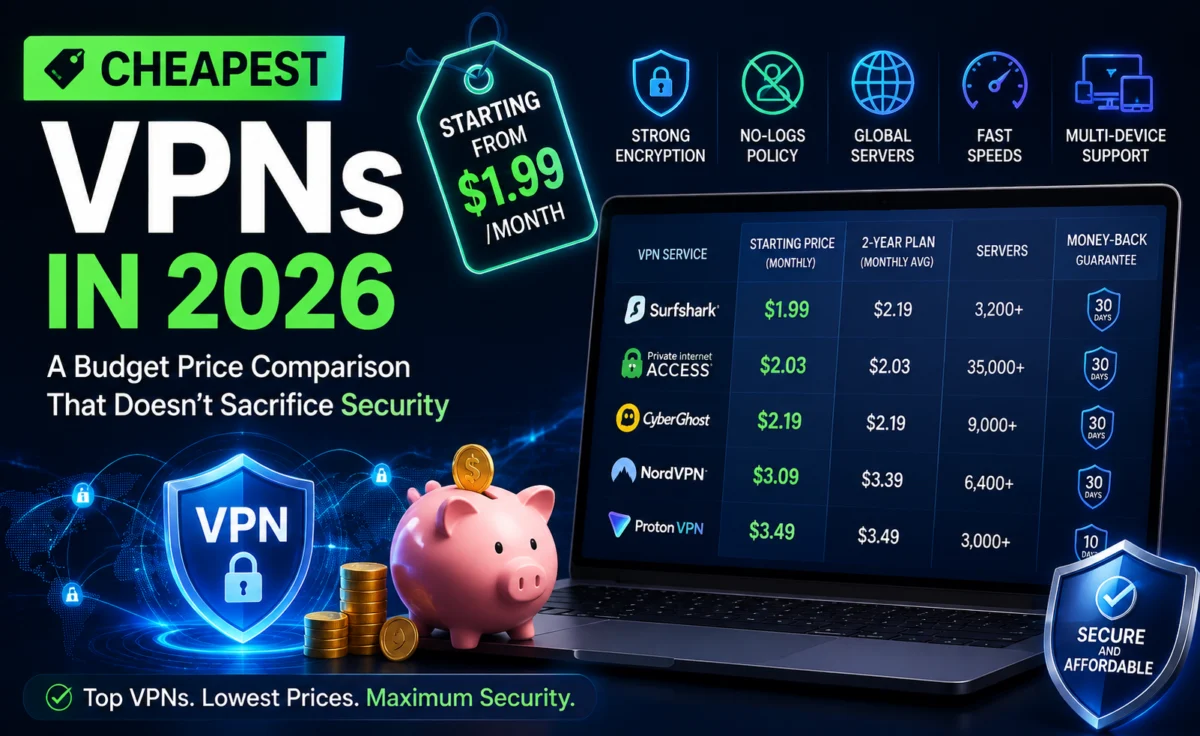
“Cheapest” and “safest” don’t have to be opposites — but the VPN market makes it easy to assume they are. Free VPNs fund themselves somehow, and it’s rarely through goodwill. Meanwhile, some of the lowest-priced paid VPNs on the market are backed by the same independent audits, no-logs verification, and modern encryption protocols as their $12-a-month competitors. The trick is knowing which “cheap” is a bargain and which “cheap” is a warning sign.
This comparison focuses purely on budget-tier paid VPNs — the sub-$4-per-month bracket — and evaluates what you’re actually getting for the discount.
💰 The Sub-$4 Club: 2026 Pricing Snapshot
| Provider | Lowest Long-Term Rate | Audited No-Logs? | Standout Trade-Off |
|---|---|---|---|
| CyberGhost | ~$1.59/mo (2-yr) | Yes | Smaller device cap (7) |
| Surfshark | ~$1.99–2.49/mo (2-yr) | Yes | Renewal price jump is steep |
| NordVPN | ~$2.99–3.09/mo (2-yr) | Yes | Not the cheapest, but close |
| Proton VPN | ~$3.99/mo | Yes | Pricier of the group, but Swiss privacy law + open-source apps |
| Private Internet Access | ~$2/mo range (long-term) | Yes | Interface feels dated to some users |
🚨 Why “Free” Isn’t on This List
We deliberately excluded free VPNs, and it’s worth explaining why. Running global server infrastructure, encryption, and support costs real money — if you aren’t paying for it with a subscription, something else is covering the bill. That’s frequently your data: many free services log activity and sell it to advertisers, which directly undermines the privacy a VPN is supposed to provide in the first place. Free tiers also tend to skip the costly independent security audits that budget paid options increasingly treat as table stakes, and some still run on older, less secure protocols.
The budget-paid tier below $4/month exists precisely to serve people who want to avoid that trade-off without paying premium prices — and in 2026, that tier has gotten genuinely good.
🥇 CyberGhost — The Lowest Sustained Price
CyberGhost’s long-term plan can dip to roughly $1.59 per month during its regular promotional cycles, and — critically — its renewal rate afterward stays comparatively low, around $3.45 per month, rather than jumping into double digits like some competitors. That combination of “cheapest entry” and “gentlest renewal” makes it arguably the most budget-friendly option that doesn’t ask you to actively manage a cancel-and-rejoin cycle every couple of years.
The device limit of 7 simultaneous connections is the main compromise, and its server network, while solid, is smaller than NordVPN’s. For a single user or couple prioritizing price above all else, that’s a fair trade.
🥈 Surfshark — Cheapest Entry, Unlimited Devices
Surfshark frequently undercuts even CyberGhost on the absolute lowest advertised rate, with some regional and promotional pricing dipping under $2 per month on its longest commitment. Its headline feature for budget shoppers is the unlimited simultaneous device allowance — a rarity at this price point — which effectively makes it the cheapest per-device VPN on the market for larger households.
The caveat, again, is the renewal cliff: Surfshark’s post-promo pricing climbs meaningfully higher, so this is a plan you want to actively monitor rather than set and forget.
🥉 NordVPN — Slightly Pricier, Noticeably Bigger Network
NordVPN isn’t the cheapest name on this list, but at roughly $3/month on its long-term plan, it’s still comfortably inside budget territory — and the extra dollar or so buys a substantially larger, more frequently refreshed server fleet than either CyberGhost or Surfshark maintains. If budget matters but you also stream, torrent, or need reliable access across many countries, Nord’s price-to-server-count ratio is hard to beat.
🔐 Proton VPN — The “Budget-Adjacent” Privacy Pick
Proton VPN sits at the upper edge of what we’d call budget pricing, around $4 per month, but it earns its spot on this list for a different reason: its open-source apps, published transparency reports, and Switzerland’s strong privacy legal framework give privacy-focused users a level of independent verifiability that’s harder to find at the very bottom of the price ladder. If your top priority is minimizing trust required in the provider itself — not just the lowest number on the checkout page — Proton is worth the extra dollar.
⚖️ Private Internet Access — The Overlooked Value Pick
PIA rarely tops “best VPN” headlines the way Nord or Surfshark do, but its long-term pricing regularly lands in the same low range as its flashier competitors, and it holds a long-standing reputation for open-source, independently audited apps. The interface feels less modern than some rivals, but for users who care more about the encryption under the hood than the polish of the app on top, PIA is consistently one of the best-value picks in this bracket.
🧭 How to Pick Among the Budget Tier
- Most devices to cover? Surfshark’s unlimited-device policy wins outright.
- Want the lowest price that stays low after renewal? CyberGhost’s gentler renewal curve is the safest bet.
- Need the biggest server map at a still-reasonable price? NordVPN.
- Privacy law and transparency matter more than shaving off another dollar? Proton VPN.
- Want proven, audited, no-frills security? Private Internet Access.
🛑 Red Flags That Separate “Budget” From “Risky”
- No independent audit history. A provider that’s never published a third-party security or no-logs audit shouldn’t be trusted purely because it’s cheap.
- Vague or missing jurisdiction information. Reputable budget VPNs are upfront about where they’re legally based and what data laws apply.
- Lifetime subscription offers. A too-good-to-be-true one-time payment for “lifetime” access is one of the more common red flags in the VPN space — providers offering these can under-invest in infrastructure or security over time, and there’s real risk of the company folding entirely, leaving your “lifetime” plan worthless.
- No free trial or short money-back window. Confidence in your own product usually comes with a generous refund policy; budget providers that skip this are worth a second look.
📐 A Simple Framework: Price Per Protected Device
Comparing raw monthly price across providers only tells half the story, because device allowances differ so much between plans. A more honest comparison metric is price divided by simultaneous device slots. Under that lens, a $2.49/month unlimited-device plan protecting six household devices works out to roughly $0.41 per device, while a $1.59/month plan capped at 7 devices for a single user protecting only two devices in practice is closer to $0.80 per device — nearly double, despite the lower headline price. Before assuming the smallest number on the page is the best deal, run this quick math against your actual device count.
🧳 Budget VPNs and Streaming: What You Give Up
One area where budget-tier VPNs sometimes lag premium competitors is consistency unblocking major streaming platforms, which routinely update their VPN-detection systems. Smaller server networks can mean fewer working streaming-optimized servers per region, and slower rotation when a given server gets blocked. This isn’t a universal rule — several budget providers on this list maintain dedicated streaming servers that perform reliably — but if streaming access is your primary use case rather than general privacy, it’s worth checking recent user reports for the specific platform and country combination you care about before committing to a multi-year plan.
🔒 Security Fundamentals Every Budget VPN Should Have
Price aside, there’s a short checklist that separates a legitimately budget-friendly VPN from a corner-cut one:
- Modern protocol support — WireGuard or an equivalent modern protocol, not legacy options like PPTP.
- Published, independently verified no-logs audit — not just a marketing claim, but a named third-party auditor and a public report.
- Kill switch functionality — automatically blocking internet traffic if the VPN connection drops, preventing accidental exposure.
- Clear jurisdiction disclosure — a provider that’s upfront about which country’s laws govern its data-retention obligations.
- Transparent renewal pricing — published, easy-to-find rates for what you’ll pay after the introductory term, not numbers buried in support articles.
Every provider covered in this comparison clears that bar. Providers that don’t — regardless of how aggressive their advertised price is — should be treated with more caution than a few extra dollars a month is worth.
❓ Frequently Asked Questions
Are budget VPNs slower than premium ones?
Not inherently. Speed depends more on server load, protocol, and physical distance to the server than on subscription price. Some budget providers use the same modern protocols as premium competitors and perform comparably in day-to-day use.
Why do “lifetime” VPN deals exist if they’re risky?
They’re attractive precisely because the upfront number looks small compared to years of recurring billing. The risk is structural: a company collecting a one-time payment has less ongoing revenue tied to keeping that specific customer’s experience strong, and there’s a real possibility the company changes hands, shuts down, or scales back infrastructure long before the “lifetime” actually ends.
Is a higher price ever worth it over these budget picks?
Sometimes — dedicated business features, obfuscated servers for restrictive networks, or specialized streaming optimization can justify a premium tier for specific use cases. For general browsing privacy and everyday streaming, though, the budget tier covered here typically closes most of that functional gap.
How often should I re-check pricing?
Roughly once a year, ideally 30 days before any renewal date. Providers regularly rotate promotional pricing, and a rate that wasn’t competitive last year may well be the best deal on the market this year, or vice versa.
✅ Bottom Line
You don’t need to pay premium prices to get a genuinely secure, independently audited VPN in 2026. The sub-$4 bracket now includes several providers that match premium competitors on core security fundamentals — the differences that remain are mostly about server count, device limits, and how gracefully (or painfully) the price behaves after your first term ends. Match those trade-offs to your actual habits, and “cheap” stops being a compromise.
Pricing referenced reflects publicly listed 2026 rates at the time of writing and can vary by region and promotion. Always verify current pricing on the provider’s official website before subscribing, and avoid providers that cannot point to an independent security or no-logs audit.
About the Author