

Every few years, indie gaming has a moment where it feels like it’s about to be swallowed whole — by rising development costs, by algorithm-driven storefronts, by a AAA industry copying whatever worked last time. And every few years, it doesn’t happen, because the thing that makes indie games valuable isn’t a trend that can be absorbed. It’s a structural difference in who gets to take creative risks. Here’s where that structural advantage is headed next.
Trend 1: The Slow Death of the “Genre-First” Pitch
For years, indie games were often described — and marketed — by genre first: “it’s a metroidvania,” “it’s a deckbuilder.” That framing is fading. The most successful releases of the past year increasingly resist a clean genre label, instead being pitched around a single mechanic or feeling: “a game about listening,” “a game about running a failing shop.” This isn’t just a marketing shift; it reflects a real change in how small teams are designing, starting from an emotional or mechanical hook rather than a genre template and letting genre fall out of that decision later, if it fits at all.
Trend 2: Shorter Games, Priced Accordingly
The assumption that a game needs forty-plus hours to justify its price tag is eroding fast in the indie space. A wave of tightly scoped, three-to-six-hour experiences — priced well below the traditional indie ceiling — have found real commercial success this year, in part because they respect a player’s time in a way that’s increasingly rare. Expect this to accelerate: smaller, cheaper, more precisely crafted experiences releasing more frequently from the same studios, rather than one team spending four years on a single sprawling project.
Trend 3: AI Tools as a Force Multiplier, Not a Replacement
The conversation around AI in game development has been noisy and often overheated, but the practical reality inside small studios is more modest and more interesting: AI-assisted tools are increasingly used for asset iteration, dialogue drafting, and rapid prototyping — freeing up small teams’ limited hours for the parts of development that actually require human judgment, like pacing, tone, and the specific creative decisions that give a game its identity. The studios using these tools well are treating them as a way to compress production time on the unglamorous parts of development, not as a substitute for design thinking.
Trend 4: Publishing Models Are Fragmenting
The traditional indie publisher relationship — funding upfront in exchange for a revenue share — is no longer the only viable path, and increasingly not even the default one. Crowdfunding has matured into a legitimate pre-order and community-building tool rather than a desperate funding measure. Revenue-share collectives, where several small studios pool marketing resources without a traditional publisher middleman, have become more common. And a growing number of successful solo developers are self-publishing entirely, using direct community channels built over years rather than storefront algorithms to reach an audience.
Trend 5: Regional Indie Scenes Are Gaining Real Visibility
Storefront curation and localization tools have improved enough that indie scenes outside the traditional North American and Western European hubs are getting meaningfully more international visibility than they did even a couple of years ago. This is producing genuinely fresh design sensibilities — narrative structures, pacing choices, and aesthetic references that don’t come out of the usual playbook — and it’s one of the more quietly exciting shifts in the indie landscape, even if it doesn’t show up cleanly in any single trend headline.
Trend 6: VR and Flatscreen Indie Design Are Cross-Pollinating
Ideas are increasingly flowing in both directions between VR and traditional indie development. Flatscreen games are borrowing environmental storytelling and object-handling ideas that were refined in VR; VR games are borrowing pacing and scope discipline from flatscreen indie design. Several studios now work across both simultaneously, treating them less as separate markets and more as two different lenses on the same design instincts.
Trend 7: Discovery Is Becoming More Human, Less Algorithmic
After years of frustration with algorithm-driven storefront discovery, both platforms and players have started leaning back toward human curation — newsletter recommendations, community-run showcases, streamer-driven discovery, and curated “best of” lists (like this one) genuinely influencing purchase decisions in a way that pure algorithmic recommendation increasingly doesn’t. For small studios without marketing budgets, this is a meaningfully more level playing field than the algorithm-first landscape of a few years ago.
Trend 8: Accessibility Is No Longer an Afterthought
Comprehensive accessibility options — remappable controls, colorblind modes, adjustable difficulty and pacing, one-handed play configurations, VR comfort settings — have shifted from a late-stage patch to a day-one design consideration across a growing share of indie releases. This isn’t charity; it’s good design and good business, expanding the practical audience for games that would otherwise quietly exclude a meaningful share of interested players.
Trend 9: Modding and Player-Made Content Are Being Designed In From Day One
Rather than treating mod support as an afterthought bolted on after a game has run its commercial course, a growing number of indie studios are shipping accessible level editors, scripting hooks, and asset pipelines alongside the initial release itself. This reflects a recognition that a healthy modding community can extend a small game’s relevance for years at essentially no additional cost to the studio, turning a single release into an ongoing platform rather than a one-time transaction. Several of the most enduring indie communities of the past decade were built this way, and newer studios are increasingly skipping the “figure it out later” phase entirely.
Trend 10: Cross-Platform Saves and Play Are Now Expected, Not Requested
Players increasingly expect to start a game on one device and continue it on another without friction, and indie studios — despite having far fewer engineering resources than a major publisher — have gotten surprisingly good at delivering this. Cloud-synced saves and, in some cases, full cross-platform play between VR and flatscreen versions of the same title are becoming a baseline expectation rather than a premium feature. This matters especially for indie developers, whose audiences are often more device-fluid than a AAA fanbase locked into a single console ecosystem.
What Doesn’t Change
Underneath all of these shifts, the core value proposition of indie gaming stays constant: small teams can afford to take the kind of creative risk that larger, more accountable studios structurally cannot. Tools change, platforms change, funding models change — but the fundamental reason indie games matter is unlikely to. As long as there’s a gap between what a big studio can safely greenlight and what a small team is willing to try on its own dime, indie gaming will keep producing the ideas the rest of the industry eventually catches up to.
Looking Ahead
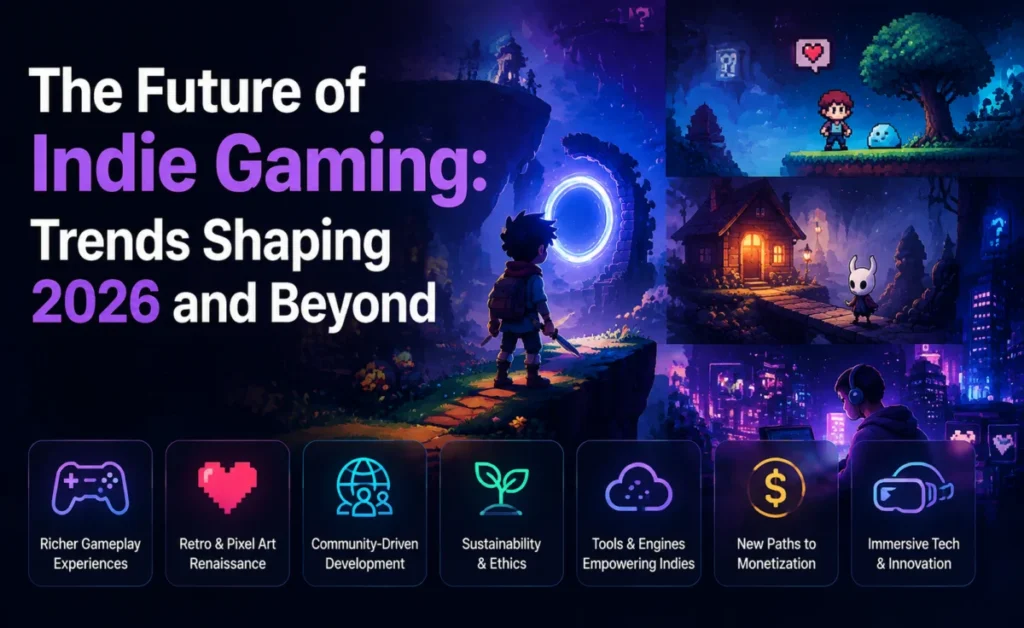
If the past year is any indication, the next twelve months will likely bring more genre-blurring, more short-form experiences priced to match, more cross-pollination between VR and flatscreen design sensibilities, and a continued shift toward human-driven discovery over algorithmic recommendation. None of that is a radical departure from what indie gaming has always been about. It’s simply the same instinct — small teams chasing a specific idea with real conviction — finding new tools and new paths to reach the players who are looking for exactly that.
A Word of Caution
It would be dishonest to frame every one of these trends as unambiguously positive. Shorter, cheaper games mean lower average revenue per title, which puts real pressure on studios trying to build a sustainable multi-year business rather than releasing one strong game and then struggling to fund the next. AI-assisted tooling, handled poorly, can flatten the specific creative voice that makes indie games worth playing in the first place, and the industry is still working out where that line sits. And the fragmentation of publishing models, while it opens up more paths to funding, also means more small studios are navigating complex financial decisions without the institutional support a traditional publisher relationship — for all its downsides — used to provide.
None of this undercuts the overall trajectory, but it’s worth holding onto some nuance here. The structural advantage indie studios have — the freedom to take creative risks a bigger studio can’t — doesn’t automatically translate into a stable business, and plenty of talented small teams will still struggle or fold even as the segment as a whole keeps producing its best work in years.
What to Watch For Next
A few specific signals are worth tracking over the next year for anyone following this space closely: whether the current wave of AI-assisted development tools produces a genuine wave of higher-quality small games or instead a glut of low-effort content that drowns out the good work; whether regional indie scenes gaining visibility now continue to grow or plateau once the initial platform curation push fades; and whether the current appetite for shorter, cheaper games holds up once the current wave of standout examples cycles through, or whether player expectations quietly drift back toward wanting more hours per dollar once the novelty wears off.
None of these questions have obvious answers yet, and that uncertainty is, in its own way, part of what makes this such an interesting moment to be paying attention to indie development at all.
Final Thought
The industry loves predicting that indie gaming’s moment is about to pass, usually right before it has its best year yet. Given everything currently in motion — in tools, in funding, in discovery, in the sheer creative confidence on display across this year’s releases — there’s little reason to expect 2026 to break that pattern.
About the Author