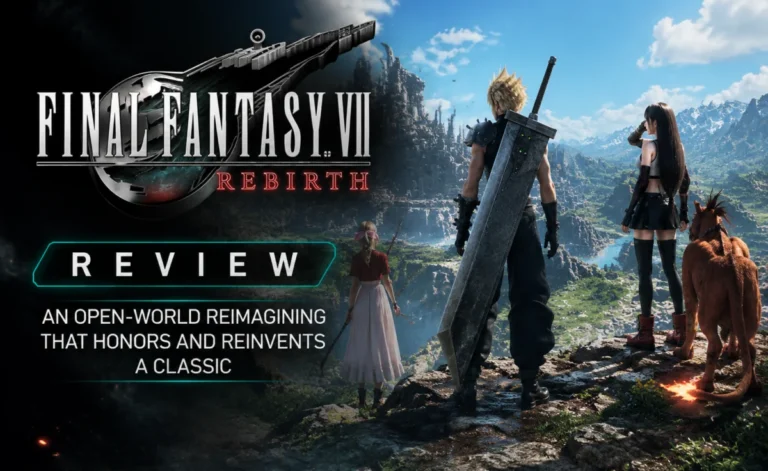

Platform: PlayStation 5 | Genre: Action-Adventure | Rating: 9.1/10
Insomniac Games had a genuinely difficult problem to solve with Marvel’s Spider-Man 2: how do you follow up a beloved web-slinging power fantasy without simply repeating it? The studio’s answer is to double nearly everything — two playable Spider-Men, two symbiote-corrupted threats in Venom and a increasingly unstable Peter, and a Manhattan-plus-Queens map roughly one and a half times the size of the original’s already-generous playground — while trimming the side-content bloat that occasionally weighed down its predecessor.
Two Spider-Men, One Believable City
Splitting the campaign between Peter Parker and Miles Morales could have diluted both characters, but Insomniac uses the structure deliberately. Peter’s chapters increasingly explore his growing exhaustion and the corrosive effect of the symbiote suit on his judgment, while Miles’s sections lean into his more optimistic, community-rooted approach to heroism. The two perspectives don’t just alternate for variety’s sake — they’re building toward a thematic collision about what happens when good intentions curdle into control.
Yuri Lowenthal and Nadji Jeter both turn in noticeably stronger vocal performances than in the previous two games, particularly during the back half’s darker material, where Peter’s symbiote-fueled aggression demands a genuinely different vocal register than the character has ever occupied before.
Spider-Man 2 understands that its emotional core was never really about villains — it’s about how much of yourself you’re willing to sacrifice to keep everyone else safe.
Traversal Has Never Felt Better
Web-swinging was already the series’ calling card, and the sequel’s headline addition — the web wings, allowing extended aerial gliding between swings — solves the original’s one real traversal weakness: crossing large gaps or open water without awkwardly falling out of momentum. Combined with a noticeably faster base swing speed, getting across the expanded map (which now includes Brooklyn and Queens alongside a revamped Manhattan) rarely feels like a chore, even on long fast-travel-avoidant sightseeing sessions.
Combat and Gadget Highlights
- Symbiote abilities give Peter devastating AOE attacks fueled by a dedicated meter
- Miles’s bioelectric Venom powers remain distinct enough from Peter’s kit to make character-switching missions feel mechanically fresh
- New parry-focused combat encounters against Symbiote-infected enemies demand tighter reaction timing than the largely combo-driven original
- Gadget customization returns with a wider tech tree split between both playable heroes
A Villain Roster That Finally Delivers
Tony Todd’s Venom is the clear headline, and the character is given enough screen time and motivation to avoid the “menacing but thin” trap that sank several cinematic takes on the same villain. Kraven the Hunter’s storyline running alongside the main symbiote plot adds a welcome grounded, hand-to-hand threat that contrasts nicely against the back half’s more cosmic-scale symbiote chaos, giving the campaign a genuinely varied rogues’ gallery rather than a single repeated boss template.
Side Content: Smaller, But Sharper
Insomniac clearly took criticism of the first game’s occasionally repetitive side-activity density to heart. Side content here is noticeably reduced in raw quantity but far more narratively purposeful — most side missions tie directly into character arcs for Peter, Miles, MJ, or a returning supporting cast member, rather than existing as disconnected crime-generator busywork.
Technical Presentation
Built specifically for PS5 without a PS4 version to hold it back, Spider-Man 2 is a genuine showcase title. Ray-traced reflections across Manhattan’s glass towers, dramatically improved crowd density, and a Performance Mode that finally holds a locked 60fps with ray tracing enabled simultaneously (a first for the series) all combine to make this one of the best-looking games on the platform. The DualSense’s adaptive triggers and haptics are put to consistently clever use, particularly during web-swinging, where trigger resistance subtly shifts based on swing tension.
Sound and Score
Composer collaboration between the game’s returning musical team delivers distinct thematic motifs for both Peter and Miles, merging into a shared, more urgent orchestral identity once the symbiote plot escalates. The sound design during traversal — the whip-crack of web-lines, the wind roar of a wingsuit glide — remains some of the most satisfying audio feedback in any open-world game currently available.
Pros and Cons
| Pros | Cons |
|---|---|
| Web wings and faster swinging make traversal near-flawless | Campaign length is shorter than the original’s main story |
| Dual protagonists genuinely enrich the story rather than diluting it | A few symbiote-power sequences lean toward spectacle over challenge |
| Venom and Kraven both land as fully realized antagonists | Some returning side-activity types feel unchanged from prior games |
| Best-in-class ray tracing plus locked 60fps performance mode | Boss patterns occasionally telegraph a bit too clearly |
New Game Plus and Photo Mode
A robust New Game Plus mode lets players carry forward unlocked suits, gadgets, and skill trees into a fresh playthrough at increased difficulty, addressing one of the more common post-credits requests from fans of the first game. The series’ beloved Photo Mode also returns with expanded filters, pose options, and — new to this entry — dedicated symbiote and Venom-specific effects overlays, catering to the game’s already-active screenshot-sharing community.
Suit Variety and Customization
Both Peter and Miles receive substantially expanded suit rosters compared to the first two games, pulling from decades of comic book history alongside several entirely new designs created specifically for this story. Suit powers are now more meaningfully distinct from cosmetic changes, with several suits granting genuinely different combat abilities rather than purely visual variety — a system that rewards experimentation rather than simply picking a favorite look and sticking with it for the whole campaign.
Accessibility Features
Insomniac has built a reputation for genre-leading accessibility support since the original Spider-Man, and the sequel continues that tradition with an extensive suite of options: customizable button-hold conversions, adjustable QTE timing (or full QTE removal), a high-contrast visual mode for colorblind and low-vision players, and full traversal assistance options for players who want to experience the story without mastering the web-swinging skill curve. Few open-world action games on the market currently match this level of granular accessibility customization.
How It Stacks Up Against the First Two Games
Measured purely against 2018’s Marvel’s Spider-Man and 2020’s Miles Morales, the sequel represents a clear technical and narrative step forward on nearly every axis, trading a small amount of side-content volume for tighter pacing and a more focused emotional through-line. Long-time fans debating series highlights will likely find this entry edges out its predecessors specifically because it commits fully to its dual-protagonist structure rather than treating Miles as a lower-budget spin-off character, as the standalone Miles Morales game arguably did by necessity.
New York’s Boroughs, Rebuilt
The addition of Brooklyn and Queens to the map isn’t merely padding — both boroughs are built with distinct architectural identities and traversal rhythms compared to Manhattan’s dense verticality, giving web-swinging genuine environmental variety across a play session rather than one continuous skyline. Coney Island in particular stands out as a memorable new open-world hub, offering a change of pace from the skyscraper-heavy core of the map that defined the previous two games’ entire traversal loop.
Boss Encounters and Set-Piece Design
Beyond Venom and Kraven, several mid-campaign boss encounters lean into scale in ways the series hasn’t previously attempted, incorporating full environmental destruction and multi-phase structure that keep even familiar villain archetypes feeling like genuine event battles rather than reskinned mob fights. The game’s willingness to interrupt open-world traversal with these tightly scripted, cinematic-adjacent encounters gives Spider-Man 2 a rhythm that alternates capably between freeform sandbox play and directed, spectacle-driven storytelling beats.
Villains as Mirrors: The Story’s Central Metaphor
What elevates Spider-Man 2’s narrative above a standard superhero sequel is its consistent framing of both Venom and Kraven as dark mirrors of Peter and Miles’s own struggles with power and control. Peter’s symbiote arc functions as a cautionary escalation of the exhaustion and resentment already simmering beneath his heroics in the first game, while Kraven’s obsessive pursuit of a “worthy death” contrasts against Miles’s more community-oriented, life-affirming approach to his own emerging power. The thematic symmetry between hero and villain pairs gives the story a cohesion that elevates it above a simple greatest-hits tour of Spider-Man’s rogues’ gallery.
DLC and the Road Ahead
Insomniac has a strong track record of supporting its Spider-Man titles with meaningful post-launch content, having previously delivered a full three-part DLC campaign for the original 2018 game. While specifics for Spider-Man 2’s own post-launch roadmap were still being finalized around release, the studio’s history suggests continued narrative expansions remain likely, extending the value proposition of an already content-rich base campaign well beyond its initial credits roll.
Final Verdict
Whether approached as a lifelong comic reader or simply as someone who enjoyed the first two Insomniac Spider-Man games, the sequel delivers on nearly every front that matters, showing clear and deliberate improvement across the board rather than incremental iteration for its own sake.
Marvel’s Spider-Man 2 doesn’t reinvent Insomniac’s formula so much as sharpen every edge of it. The expanded map, refined traversal, and genuinely affecting dual-protagonist story make it a rare superhero sequel that understands escalation doesn’t have to mean more of everything — just more of what mattered in the first place. It’s a shorter, tighter, and ultimately more emotionally resonant experience than its predecessor.
Aovory Score: 9.1/10 — The best traversal in gaming wrapped around the series’ most affecting story yet.
About the Author