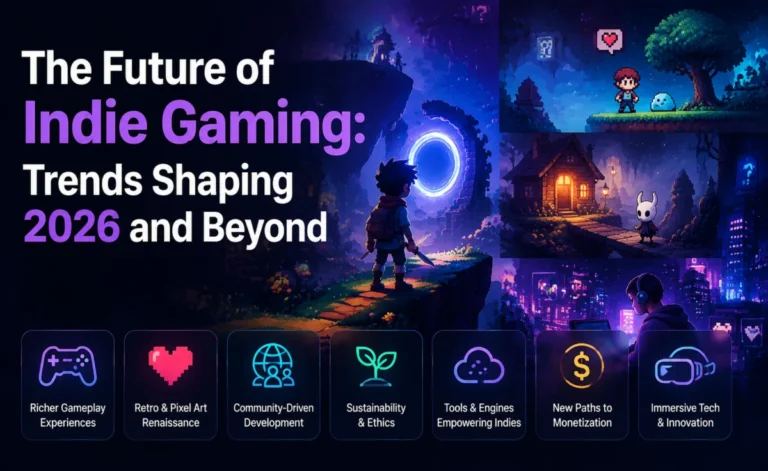

The flatscreen indie scene has had an unusually strong stretch, and it’s the kind of year where the “hidden gem” label barely applies anymore — several of these titles have sold well enough, and been talked about loudly enough, that calling them hidden feels dishonest. What they still share, though, is the thing that makes indie games worth following in the first place: a point of view no committee would have approved.
How We Picked These Seven
Rather than chase raw sales numbers, we prioritized games that are doing something structurally different — a mechanic, a pacing choice, an art direction — that a bigger, more risk-averse studio simply wouldn’t have greenlit. Genre variety mattered too; this list deliberately avoids stacking five roguelikes on top of each other, because so does the actual indie landscape right now.
1. A Turn-Based Tactics Game With Permanent, Visible Consequences
Most tactics games let you reload and try again. This one doesn’t — every wounded unit carries a visible, permanent scar into every future mission, and the game’s difficulty curve is built entirely around managing an army that gets weaker, stranger, and more attached to you the longer you play. It’s a small rule change with enormous emotional weight, and it’s the rare tactics game that makes losing feel like part of the story rather than a failure state to undo.
2. A Metroidvania That Redraws Its Own Map As You Play
The genre’s central pleasure — building a mental map of an interconnected world — gets a clever twist here: the map itself is unreliable, subtly shifting to reflect the protagonist’s degrading memory. Areas you’ve already explored don’t always look the way you remember them, and the game trusts players to feel unsettled by that rather than explaining it away. Tight combat and generous movement options keep it from ever feeling like a gimmick.
3. A Management Sim About Running a Failing Small Business
Business sims usually chase growth. This one is about the slow, dignified process of managing decline — keeping a beloved but doomed shop open a little longer, making the hard calls about what to cut first, and finding small victories inside an ultimately losing game. It sounds bleak on paper and plays, somehow, as one of the warmest, funniest games of the year.
4. A Narrative Puzzle Game Told Entirely Through Overheard Conversations
You never see a single character on screen. Instead, you piece together an entire mystery from fragments of conversation drifting through apartment walls, café tables, and phone calls on the street — rearranging what you’ve heard to uncover contradictions and hidden timelines. It’s a genuinely novel structure for a mystery game, and one that rewards close listening more than any other release this year.
5. A Cooperative Physics Platformer Built for Exactly Two Players
Designed from the ground up for two people sharing one couch or one voice call, this platformer’s puzzles are built around asymmetric information and physical trust — one player can see platforms the other can’t, and success depends entirely on communication rather than individual skill. It’s become something of a relationship stress-test in the best possible way, and one of the funniest co-op experiences in years.
6. A Roguelike That Turns Deckbuilding Into City-Building
Instead of a hand of cards, you’re placing tiles that form a small, ever-shifting city block by block, with synergies emerging from geography rather than card combos. Runs feel less like optimizing a deck and more like watching an ecosystem take shape, and the genre’s usual “find the broken combo” instinct gets replaced by something closer to urban planning.
7. A Slow, Wordless Adventure About Rebuilding After a Disaster
With no dialogue and almost no text at all, this quiet adventure follows a small community piecing itself back together after an unnamed catastrophe, told entirely through environmental storytelling and a hauntingly restrained soundtrack. It’s the kind of game that asks for patience up front and repays it completely, becoming one of the most quietly devastating releases of the year.
What Ties These Seven Together
None of these are the loudest, flashiest releases of the year — that’s rarely where indie games compete. What they share is a willingness to take one unusual idea completely seriously and build an entire game’s worth of systems, pacing, and tone around supporting it, rather than diluting it with unrelated features bolted on for scope’s sake.
That kind of focus is difficult to manufacture at scale, which is exactly why indie games remain the section of the industry worth watching most closely. Bigger budgets can buy better lighting and denser open worlds; they can’t buy the specific, slightly odd conviction that makes a small team spend two years perfecting a single mechanic nobody asked for.
Honorable Mentions
- A minimalist puzzle title built entirely around sound design and no visuals beyond a single light source
- A deckbuilding roguelite set inside a haunted library that reshuffles its own floor plan each run
- A cozy farming sim that quietly incorporates real seasonal astronomy into its calendar system
- A stealth game where the only tool available to the player is the ability to slow down time, never stop it
- A dialogue-driven courtroom drama where every verdict is remembered and referenced in future playthroughs
How to Actually Choose Between Them
With seven very different games competing for a limited amount of free time, it’s worth thinking about fit rather than trying to play all of them at once. If you gravitate toward games you can pick up in short bursts, the business management sim and the puzzle-conversation game both reward five- or ten-minute sessions without losing their thread. If you’re looking for something to sink a full weekend into, the tactics game and the metroidvania both have the systemic depth to support fifteen-plus hours without repeating themselves.
The two-player platformer deserves a special note: it is, deliberately, not a game to play alone. Its puzzles are built around asymmetric information that only works with a second real person on the other end, so it’s worth holding onto until you have the right co-op partner rather than treating it as another item on a solo backlog.
What This Says About the Indie Market Overall
Looking at these seven titles side by side, what stands out isn’t just their individual creativity but how little genre overlap there is between them. A tactics game, a metroidvania, a business sim, a narrative puzzle game, a co-op platformer, a roguelike, and a wordless adventure — that’s about as broad a spread as seven games can cover, and it’s a reasonably accurate snapshot of where indie development’s energy is actually going this year. Rather than clustering around whichever genre performed best last cycle, small studios appear to be spreading out, each staking a claim on a specific, under-explored idea rather than competing directly with each other inside the same crowded lane.
That’s a healthy sign for the segment as a whole. A market where every successful indie game inspires five clones tends to flatten out quickly; a market where success comes from genre-crossing specificity tends to stay interesting far longer, because there’s no obvious formula to copy.
A Word on Price and Value
None of these seven games are trying to compete on scale with a big-budget release, and their pricing generally reflects that honestly — most sit well below what a sprawling open-world title would charge, with runtimes and scope calibrated to match. That’s worth calling out because it runs against an old, lingering assumption that a game’s price should track its hour count above all else. A tightly crafted six-hour experience with no filler content can deliver more genuine value than a bloated forty-hour game padded with repetitive busywork, and increasingly, both players and reviewers are pricing that distinction into how they talk about value rather than defaulting to a simple cost-per-hour calculation.
This shift benefits smaller studios directly. When “shorter but sharper” becomes an accepted, even preferred, category rather than something to apologize for, teams without the resources to build forty hours of content can compete honestly on craft rather than being penalized for scope they were never going to have anyway.
Where to Start If You Only Have Time for One
Given limited time, the single easiest recommendation on this list is the wordless disaster-recovery adventure — it asks the least of new players in terms of genre familiarity or mechanical complexity, and its emotional impact tends to land regardless of what kind of games someone usually plays. For players who already know they gravitate toward strategy and systems, the tactics game with permanent scarring is the more rewarding entry point, offering the kind of depth that rewards a second and third playthrough once the initial shock of its central rule has worn off.
Whichever one you start with, the larger point stands: this is a genuinely strong year for the segment of the industry least equipped to shout about it, which is exactly why lists like this one exist in the first place.
Final Word
If there’s a throughline across this year’s best indie releases, it’s confidence — a willingness to trust a strange idea, a slow pace, or an uncomfortable theme without padding it out or apologizing for it. That confidence is, more than any specific genre or mechanic, the actual signature of a strong indie year, and 2026 has it in abundance.
About the Author